October 26, 2011
By Joe St. Henry
Review Editor
Each January, Lake Orion
resident Harlan Neuville, 80, and his family clear snow on the frozen
lake where one of his ten children lives and enjoy a day of firing model
rockets high into the sky.
Watching the streaking toys
undoubtedly brings back memories of Neuville’s days working on NASA’s
Apollo space program. He played an important role in launching
America’s astronauts into orbit and then taking them to the moon and
back.
“President Kennedy had no choice but to say we’re going to
the moon (in 1961), since the Russians had already beat us to Earth’s
orbit,” he said. “This would take entirely new technologies and
systems. He said we would accomplish it within ten years and we made
it.”
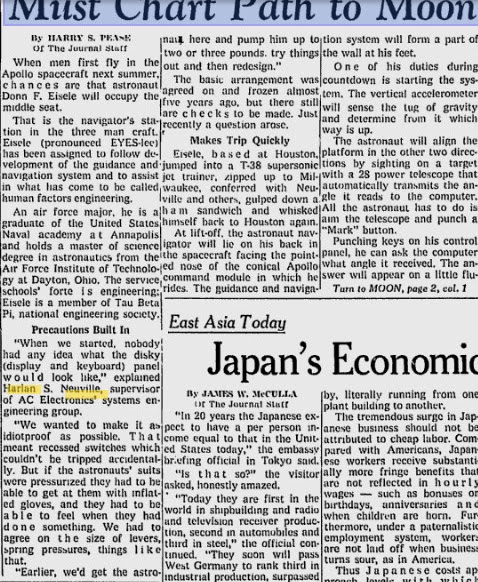
Neuville was an electrical engineer at the time, working for
Delco Electronics in Milwaukee. He was building guidance and
navigation systems for the Titan ICBM nuclear missiles. The navigation
technology employed to navigate a ship through space was similar, so he
started working on these systems for the Apollo program.
“I
definitely thought it was possible to send a man to the moon,” he said,
noting that the many engineers on the Apollo project regularly worked
60-70 hour work weeks. “We had a three year jump, since we’d already
developed a system like this for the Titan program. It would have to be
adapted for the Apollo program, but we were always working with the
latest technology available.”
Neuville said hundreds of thousands
of engineers and support staff mobilized across the country – most of
who worked for private companies and universities – to develop the space
ship, booster rocket, command center and launch tower. The U.S.
government engaged the scientific community to reach the moon much like
it did to build the atomic bomb, Neuville said.
The question on
everyone’s minds, Neuville added, was would the Saturn V rocket work?
Smaller booster rockets had put one- and two-man space capsules into
space, but a moon shot would require a three-man orbiter, plus landing
module and other equipment.
During the Apollo program, Neuville
was in Mission Control to manage the space ship’s navigation and
guidance systems. His team helped astronauts orbit the moon for the
first time. In 1969, Neil Armstrong and Buzz Aldrin became the first
humans to land on its surface.
“We were just relieved that the
technology worked,” he said. “It got them there, but now we had to get
them home. We weren’t sure if they could actually get off the moon.
“Nobody celebrated until they splashed down in the ocean,” he admitted.
There
were plenty of nervous moments for the engineers, none more unsettling
than during the Apollo 13 mission, where an explosion onboard the space
capsule on the way to the moon severely damaged the ship and endangered
the crew.
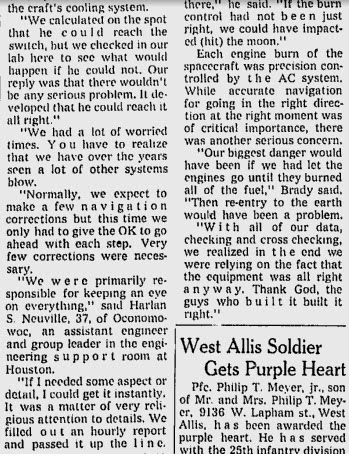
“We had to shut the navigation and guidance systems
down to conserve power,” he said. “These were very delicate components
and were designed to stay on the whole time. Once we shut them off, we
had to sweat it out because we weren’t sure if they would turn on again.
“We took a big chance, but there really wasn’t an alternative.”
Fortunately,
the engineers’ gamble paid off. The ship eventually returned home
five-days later with the astronauts’ oxygen supply virtually exhausted.
Neuville
supported a total of six lunar landings, the last of which took place
in 1972. After that, he worked on navigation and guidance
system-support for Skylab and the Apollo-Soyuz space mission with the
Soviet Union.
Delco Electronics did not win the contract to help
build the space shuttle, so Neuville was assigned to parent company
General Motors Corporation’s technical center in Warren, Mich., in the
late 1970s. He worked on various transportation systems, as a director.
He watched the shuttle program, which ended this year, from a distance.
“I thought the space shuttle was really cool,”Neuville said. “We took
people other than test pilots into space. They were scientists with a
different outlook on why we should be there.
“We’ve learned more from the Hubble telescope (put in orbit by the shuttle) than anything else,” he added.
Neuville
retired from the automotive industry in 1995. In addition to teaching
computer science in the past at Oakland University, his love of flying
and space has never waned. He likes to fly radio-controlled airplanes –
some with wingspans as big as 12 feet – as well as launch his model
rockets.
“I don’t build rockets now,” he said. “I just like to fly the plastic, assembled ones. Those are a lot easier.”
Neuville hopes the United States returns to space someday. “Man is curious,” he said. “We gotta go.”
Surprisingly, he said he never wanted to step foot in the shoes of the astronauts he worked with during the Apollo program.
“No,
I couldn’t tolerate the training,” he said. Those astronauts were very
motivated people. Heck, they were fighter pilots and had that
mentality. You put me in 10gs (ten times gravity) and I would die.”
Today,
Neuville speaks in front of groups about the Apollo space program, his
small role and the technology involved in putting people on the moon 50
years ago. His next presentation is on Oct. 27, at the Orion Township
Public Library.
“People are just awed by my stories,” he said.
“It’s hard to explain. We were just ordinary people doing our jobs.
But, given the right organization, we did an extraordinary thing. We
sent man to the moon.”